
Frontpage | The
Author | The
Books | The
Illustrations | The
Storyteller | Talks
on Writing | Teacher
Reviews | Children's Reviews | INTO Reviews | Children's Art | Library Reviews |
Bookshop Reviews | Newspaper Reviews | Guest Appearances | Bookshops Visited | Schools Visited | Libraries Visited | School Crests | Video
Clips | Costume Photos | Format
of Visit | Book Sales | Contact
Me
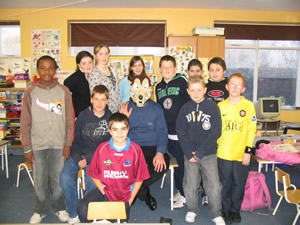
I do my Talk on Getting Started in Creative Writing for Fifth and Sixth class Primary School children, Secondary School students, Adult Education Groups and Local Writers Circles. My talk is all about developing their writing skills commercially. It is about writing to get published and to get paid for it. Think of me as a Young or New Writers’ Start-up Kit.
The first thing I tell the children is how wonderful it feels to go into a bookshop and see a book or books you have written on the shelf. I tell them how amazing it is to have somebody buy your book and then to ask you to sign it for them. Or to go into a newspaper shop and see newspapers or magazines that have articles or short stories in them that you wrote. It is a great feeling to know you did this all by yourself, by simply using your imagination.
Your imagination is a natural and inexhaustible resource once tapped into tends to expand infinitely with use.
My aim during my talk is three fold;
1. To encourage those who are interested in creative writing to start.
2. To show them how to build a book from the initial idea right up to the finished product.
3. To give them a practical project to start them off either by themselves or as part of a wider classroom project.
My talks are designed to encourage those who are interested in writing to develop their skills. I show them how to plan out a book before they write a word. I cover such topics as initial ideas, research, the process of writing and editing, bringing in characters, rewriting, presentation and marketing right up to what they send to a publisher.
I do this by taking a fairly simple and practical project to get them started. I talk them through it step by step, by getting them to use their imaginations and answering any questions along the way. Questions are welcomed and encouraged throughout my talk.
I don’t get the children to write anything for me. To do so would be to imply that I was going to read it and offer my opinion on it. This I feel would be counter-productive, as I am the Guru of Nowhere. For me to comment on whether an individual’s work was good or bad would merely be my opinion and I could very well get it wrong. Two professional editors turned J.K. Rowling’s first Harry Potter book down. In their opinion it was just “not up to scratch.” Sometimes even well educated, experienced, professionals can get things wrong - sometimes very wrong.
My purpose here is to show the children HOW TO DO IT and to ENCOURAGE them TO TRY. I tell them about other young Irish people their own age who have written books, got them published and have been paid for their efforts. On many occasions these young people have gone on to write other books. I try to open their minds to the possibilities, by giving them the courage and the determination and the KNOW HOW to do it for themselves and not to “just sit back and talk about doing it.” I stress to them “you cannot sell what you have not written.”
My talk takes about 60/90 minutes depending on the time slot available on the day.
Special Note: I also do a Follow-up Questions & Answers Session. This can take place a number of weeks after my visit, when the children have produced a body of their own work. At that point they may feel they have a number of questions they would like to ask me based on their own individual experience of putting into practice what I had told them in my Talk on Creative Writing. This session is driven by the children themselves to clarify their concerns.
© 2015 Liam Farrell